Master Mountain Biking: Conquer Rooty Descents with Confidence and Control
 Justus
There is a moment every mountain biker knows. You are flying down a trail, feeling the flow, when suddenly the ground ahead turns into a chaotic web of exposed roots, loose rocks, and steep drop-offs. Your heart rate spikes. Your hands grip the bars a little tighter.
Technical downhill sections are the ultimate test of skill and nerve in mountain biking. They separate the tentative riders from the confident ones. But here is the secret: you don’t need to be a pro to conquer them. You just need the right technique. This guide will break down the three pillars of tackling nature’s gnarliest obstacles: body positioning, brake control, and line choice.
The Foundation: Body Positioning
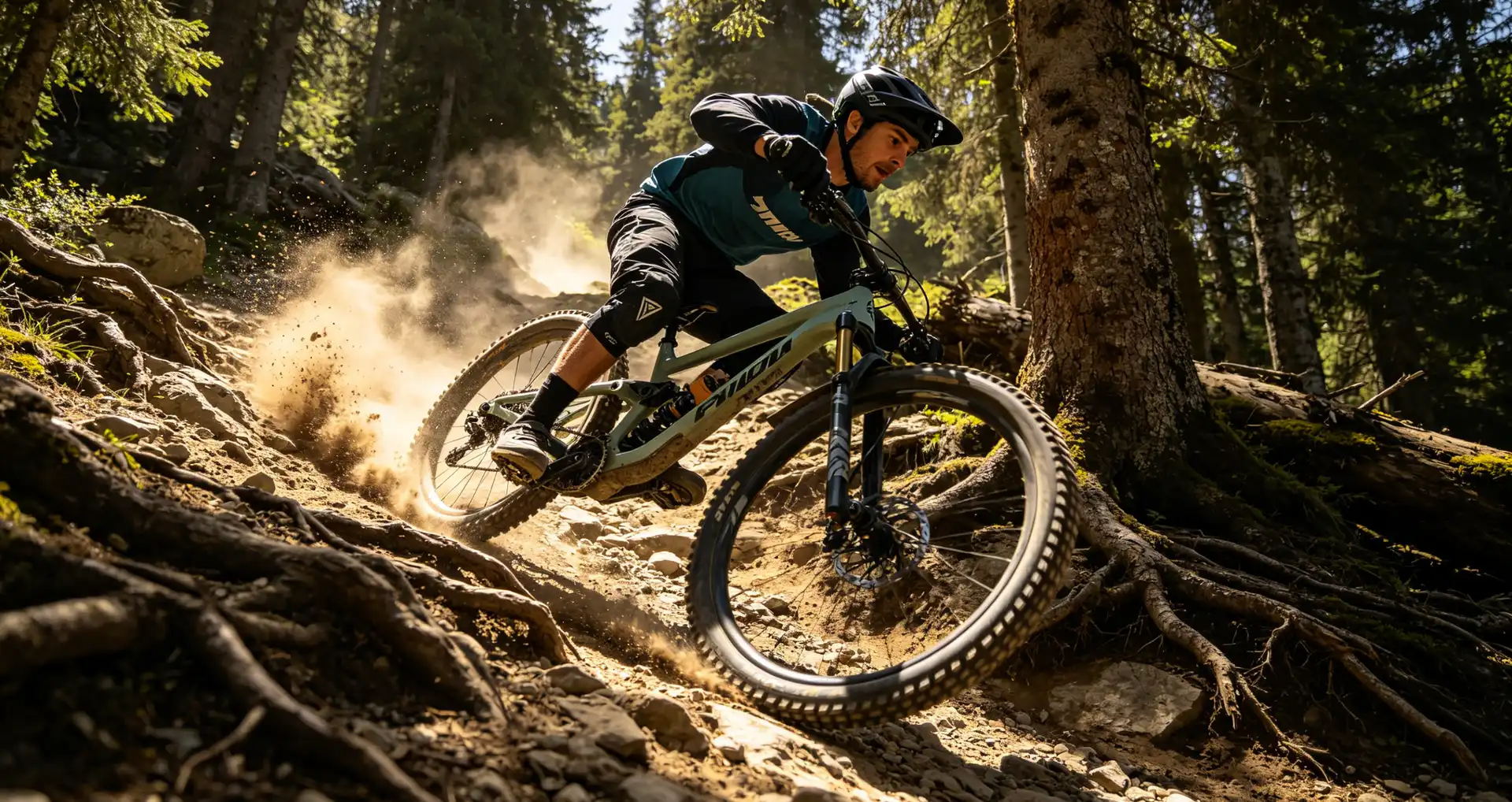
The first mistake most riders make on a steep, rooty descent is sitting back too far. While leaning back seems logical to avoid going over the bars, it actually removes your ability to steer and absorb bumps.
Instead, adopt the neutral attack position:
- Level pedals: Keep your cranks parallel to the ground. This prevents your pedals from catching on roots.
- Low center of gravity: Bend your knees and elbows. Think of yourself as a spring, ready to absorb impact.
- Heels dropped: This locks your feet onto the pedals and prevents you from being bounced off.
- Eyes up: Look through the section, not at your front wheel. Your bike will go where you look.
On a steep root ladder, the key is to let the bike move beneath you. Keep your chest low and over the handlebars, but hinge at your hips rather than arching your back. This keeps your weight centered, allowing the front wheel to track through the terrain without washing out.
The Art of Brake Control
Panic braking is the number one cause of crashes on technical descents. Grabbing a handful of brake locks your wheels, turns your tires into skis, and sends you sliding into the nearest tree.
Mastering modulated braking changes everything.
Front brake: Your front brake provides 70-80% of your stopping power. Use it gently and progressively. On a steep, rooty pitch, apply the front brake just before the front wheel hits a root. Tapping it lightly loads the tire, giving it more traction as it rolls over the obstacle.
Rear brake: The rear brake is your speed adjuster. Use it to control your momentum, not to stop. Lightly drag the rear brake to keep your speed in check. If your rear wheel starts to slide, release the brake immediately.
The golden rule: Brake before the obstacle, not on it. If you brake while your wheel is on a slippery root, you will lose traction. Instead, scrub speed early, then let the bike roll freely over the rough section. Feather the brakes, don’t grab them.
Choosing Your Line
Line choice is about seeing the path of least resistance—and the most traction. In technical mountain biking, a good line isn’t always the smoothest one.
| Goal | Strategy |
|---|---|
| Avoid roots | Look for gaps between roots where your tires can find dirt. |
| Climb over roots | Hit them straight on, at a 90-degree angle. Never hit a root diagonally. |
| Use momentum | Keep your speed steady. Hesitation causes you to stall on obstacles. |
| Pick a focal point | Look several bike lengths ahead. Your bike will follow your eyes. |
A common mistake is fixating on the root directly in front of you. This causes you to target it—and hit it poorly. Instead, scan the trail ahead. Identify a “safety zone” where you want to exit the section. Then, pick the series of smaller moves that get you there.
Sometimes, the best line is a braking bump—a small rock or root that you can use to slow down before a bigger drop. Use the terrain to your advantage.
Practice Makes Permanent
You won’t conquer rooty descents on your first try. You will need to build muscle memory. Find a local trail with a short, rooty section that challenges you but doesn’t scare you. Ride it slowly at first. Focus on one element at a time: body position, then braking, then line choice.
A final tip: Loosen your grip. White-knuckling the bars transfers vibration into your arms, making you fatigued and less precise. Hold the bars firmly but gently. Let the bike dance beneath you.
With practice, those rooty nightmares will become your favorite parts of the trail. You will stop fearing them and start seeking them out. That is the real joy of mountain biking—the constant challenge to improve, to flow with the trail, and to conquer what once seemed impossible.
Now get out there and ride. The roots are waiting.