Climbing Like a Chamois Endurance Tips for Steep Traction
 Justus
The climb. For some mountain bikers, it’s a necessary evil to reach the downhill reward. But what if you could transform those grueling ascents into a confident, efficient, and even enjoyable part of your ride? Endurance and traction are the twin pillars of successful climbing, especially on steep, loose terrain. The goal isn’t just to get to the top—it’s to arrive without burning out, losing traction, or dabbing a foot down. Let’s break down how to climb like a sure-footed chamois, mastering weight distribution, smooth pedaling, and the art of staying seated.
The Foundation: Stay Seated and Find Your Rhythm
The most common mistake on steep climbs is standing up too early. While standing can deliver a burst of power, it often sacrifices rear-wheel traction and rapidly depletes your energy stores. For long, sustained climbs, seated riding is your weapon of choice.
- Why seated? It keeps your weight centered over the rear wheel, maximizing traction where you need it most. It also engages your glutes and hamstrings—larger, more endurance-oriented muscles—rather than relying solely on your quads.
- Find your gear. Shift to an easier gear than you think you need. The goal is a smooth, circular pedal stroke at a cadence of 70-90 RPM. Pedaling squares (mashing) wastes energy and causes wheel spin on loose surfaces.
Weight Distribution: The Art of the Forward Lean
To keep the front wheel from wandering or lifting on steep pitches, you must master active weight distribution. Think of your bike as a seesaw.
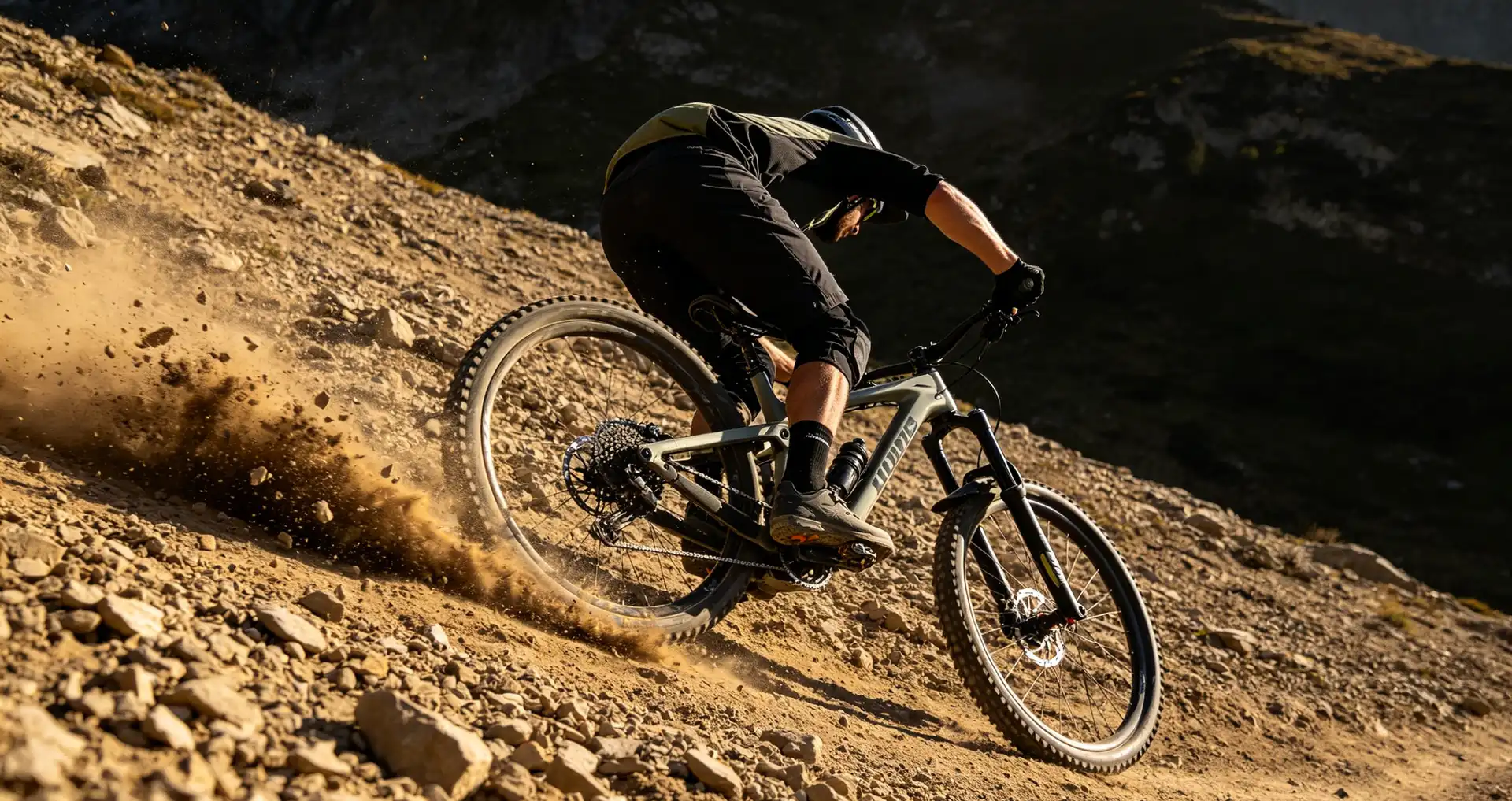
- Move your hips forward: Slide forward on the saddle to get your weight over the bottom bracket. This is your default climbing position.
- Lower your chest: Keep your chest low and close to the handlebar. This lowers your center of gravity and creates a more aggressive, stable position.
- The “Chamois” Position: When the trail steepens, you’ll need to move even further forward. Keep your heels dropped, drive your knees out from your hips, and actively hinge at your hips to push your chest toward the stem. This isn’t a static pose—adjust your weight as the angle changes.
Pedal Smoothly: Spin to Win
Erratic, choppy pedaling is the enemy of traction on loose climbs. Every time you stomp on the pedal, you risk breaking the rear tire loose.
- Focus on the circle: Practice pedaling in a smooth, fluid circle. Think about pulling up through the bottom of the stroke and over the top.
- Feather the pedals: On loose or rocky sections, reduce your power output briefly to let the tire find grip. Think of it as “pedaling with butterflies.” A small, controlled burst of power is often better than a full, uncoordinated mash.
- Use the trail’s features: When possible, pedal over small rocks or roots that offer a solid platform rather than trying to float over loose gravel.
When to Stand (and How to Do It Right)
Even the chamois must rise on the steepest, most technical sections. The key is to do it as a transition, not a default.
- The trigger: Stand only when the trail steepens so much that your front wheel starts to lift or you lose the ability to maintain a smooth seated cadence.
- The technique: As you stand, shift your weight dramatically forward. Lean your torso down toward the handlebar, and drop your heels. Keep your head up, looking ahead to your line. Your goal is to keep the rear wheel planted while moving your center of gravity forward to prevent a wheelie.
- Short bursts: Standing is for power, not endurance. Get the bike over the obstacle or through the steep pinch, then quickly sit back down and resume your seated rhythm.
Trail Reading: The Often-Forgotten Skill
Climbing isn’t just about bike handling; it’s about vision.
- Look ahead, not down. Your bike will go where your eyes go. Staring at your front wheel invites a crash. Instead, pick a line 10-20 feet ahead.
- Choose your line for momentum. On loose or rocky climbs, a smooth, consistent line that carries speed is often better than the most direct one. Look for hard-packed patches, roots, or small rocks that offer solid tire contact.
- Commit to the line. Once you pick a line, commit fully. Hesitation leads to wobbling and loss of forward momentum.
Gear Up for the Long Haul
Don’t make the climb harder than it needs to be.
- Tire pressure: Running lower tire pressure can dramatically improve traction on loose climbs. Experiment with pressures (start with 25-28 PSI for a tubeless setup).
- Dropper post: Keep your dropper post down on steep climbs to allow for weight shifts without hitting the saddle in the stomach.
- Gearing: Consider a wider-range cassette or smaller chainring if you consistently find yourself spinning out or struggling to maintain a steady cadence.
Final Thoughts
Climbing like a chamois isn’t about raw power. It’s about patience, precision, and efficient technique. Focus on staying seated, moving your weight forward, pedaling smoothly, and reading the trail ahead. Practice these principles on your local climbs, and soon you’ll find yourself conquering those steep, loose pitches with more confidence, less frustration, and plenty of energy left for the descent. The mountain is waiting. Start climbing.