“Cyclists fare best when they act and are treated as drivers of vehicles.”
That sentence, written by John Forester in the 1970s, has shaped American cycling policy for half a century. It sounds reasonable at first glance — take the lane, be predictable, claim your space. But peel back the layers and you find a philosophy built not on evidence but on ideology, pushed by a man who actively sabotaged the very infrastructure that has since proven to save lives around the world.
John Forester was an engineer by training and a zealot by temperament. He did not merely advocate for riding in traffic as a legitimate strategy. He waged war against bike lanes, arguing that separate cycling infrastructure was not just unnecessary but actively dangerous. Throughout the 1970s and 1980s, he lobbied against efforts to bring Dutch-style protected infrastructure to the United States — and by his own account, he succeeded. He bragged about it. American cities spent decades building roads for cars alone because Forester and his followers convinced planners that cyclists did not need anything more than asphalt and assertiveness.
His intellectual methods were not, by any rigorous standard, honest. He cherry-picked data from studies, ignored findings that contradicted his position, and drew conclusions that the original researchers explicitly rejected. The Wachtel and Lewiston studies from the same era followed a similar pattern of selective analysis dressed up as science. Yet the vehicular cycling doctrine took hold anyway, spreading through advocacy groups, traffic engineering textbooks, and the collective wisdom of the American cycling community. Forester died in 2020, but his ideas are still out there, still shaping policy, still getting people hurt.
Here is the uncomfortable truth that Forester refused to accept: cyclists fare best when they do not collide with cars. And the best way to prevent those collisions is physical separation. No amount of pretending you are the same as a car will change the fundamental physics of the situation. You are not nearly as fast as a car. You are not nearly as massive as a car. In objective terms, a cyclist has far more in common with a pedestrian than with a two-ton metal box traveling at forty miles per hour. Your mass is comparable to a pedestrian. Your speed is often closer to a pedestrian than to a motor vehicle. Yet vehicular cycling insists you should behave as though you belong in the same lane as traffic.
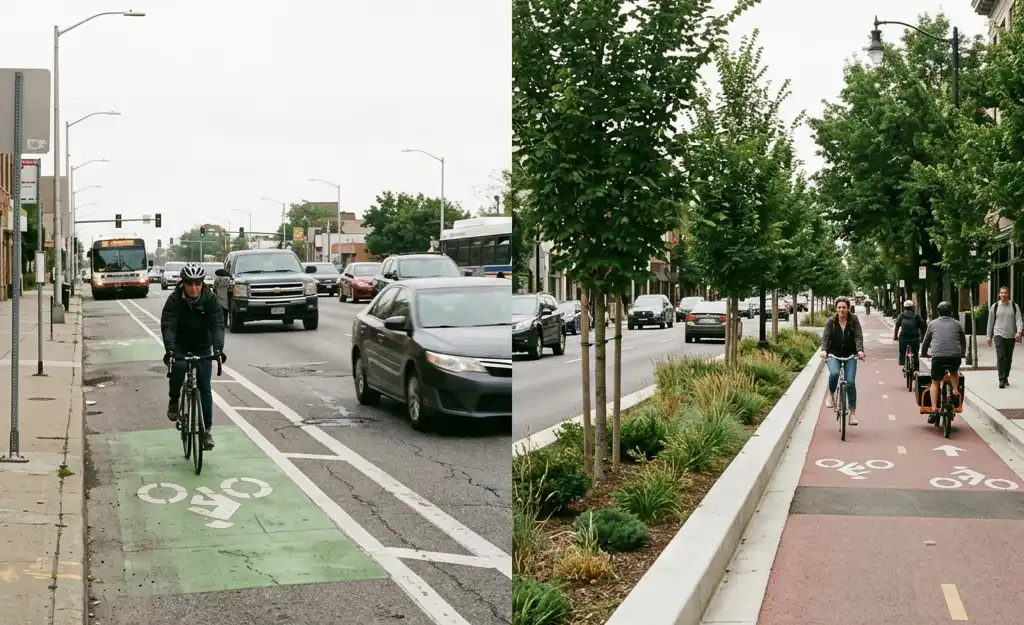
The data tells a clear story. A 2011 study of Montreal’s cycle track network found a 28 percent reduction in injuries after the installation of protected bike lanes. That is not a marginal improvement. That is nearly a third fewer people ending up in emergency rooms, achieved by building a physical barrier between bicycles and motor vehicles. Look across the Atlantic and the numbers become even more striking. The Netherlands has a cyclist fatality rate roughly one-fifth that of the United States per 100 million kilometers traveled. One-fifth. And the Dutch did not achieve this by teaching cyclists to take the lane with confidence. They built an entire network of separated infrastructure — paths that look, at a glance, like color-coded sidewalks reserved for bicycles, with thoughtful adaptations at intersections that keep riders visible and traffic orderly.
What is especially telling is how the Dutch place pedestrian sidewalks directly adjacent to these bike paths without apparent conflict. Forester’s camp has long argued that separating cyclists from cars simply shifts the danger to interactions with pedestrians. The Dutch experience suggests otherwise. With clear visual distinctions, sensible design, and a culture that respects both modes, pedestrians and cyclists coexist just fine. The actual danger was never the people walking. The danger was always the cars.
The cycling community has been spectacularly wrong before. For years, the dominant belief was that skinny tires pumped to extreme pressures were the secret to speed. Riders suffered through bone-rattling rides because the received wisdom said narrower was faster. We now know that wider tires at lower pressures often roll more efficiently on real-world surfaces while offering far more comfort and control. The entire industry has shifted. If we could be that wrong about something as measurable as rolling resistance and tire performance, perhaps we should entertain the possibility that we have also been wrong about road safety.
Forester’s vehicular cycling philosophy is not a harmless difference of opinion. It is a doctrine that has, for five decades, provided intellectual cover for cities that did not want to spend money on bike infrastructure. It told planners they could do nothing and call it a policy. It told cyclists that if they got hit, they were probably doing it wrong. And it left American riders with a fatality rate five times higher than their Dutch counterparts, riding on roads that were designed as if they did not exist.
The solution is not complicated. It is not expensive relative to the cost of building and maintaining roads for cars. It is not untested or experimental. It has been working in the Netherlands for decades. Separate cyclists from cars with physical barriers. Build networks, not fragments. Treat cycling infrastructure as infrastructure, not as paint on asphalt. The evidence is overwhelming. The only thing standing in the way is the lingering ghost of a man who insisted that a bicycle is a vehicle and the road is where it belongs — a claim that physics, data, and every country that has actually solved this problem have proven spectacularly wrong.