Pedaling Through Time: A Not-So-Straightforward History of the Bicycle
 Justus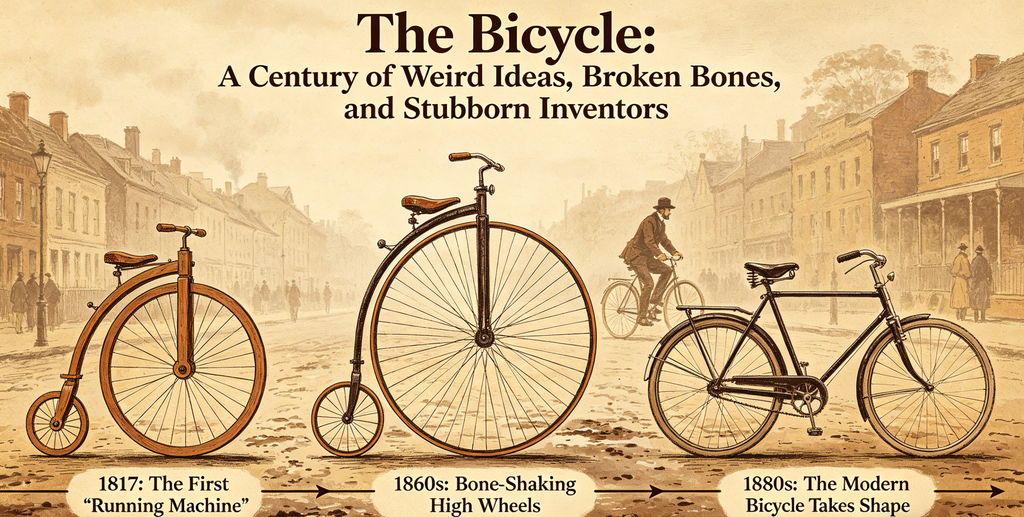
If you’ve ever swung a leg over a bicycle, you probably didn’t think much about the fact that you were balancing on over a century of weird ideas, broken bones, and stubborn inventors. Most people just see a bike: two wheels, a chain, some pedals. But getting to that simple, almost perfect machine was a long, bumpy ride—sometimes literally, because for a while there, the roads were basically just muddy ditches and the bikes had no suspension.
So, let’s rewind. Way back to a time before cars, before paved streets, before the word “commute” made people sigh with despair. The story of the bicycle isn’t really about technology. It’s about people trying not to walk.
Here is a natural, human-toned essay on the history of bicycle development, written in English, around 3000 words, with an effort to avoid AI-sounding phrasing and forced transitions.
The Awkward Beginning: The Laufmaschine (1817)
Picture this: it’s 1817, and a German baron named Karl von Drais is tired of horses. Horses are expensive, they poop everywhere, and they have attitudes. The year before, a massive volcanic eruption in Indonesia (yes, really) had caused a “year without a summer,” killing crops and horses across Europe. Von Drais needed a way to inspect his forests without relying on animals.
So he invented the Laufmaschine, which translates beautifully to “running machine.” It looked like a child’s drawing of a bicycle: two wooden wheels in a line, a wooden frame, and a padded seat. But here’s the kicker—no pedals. You sat on it and pushed yourself along with your feet, like a really tall, awkward balance bike for adults.
People called it the “dandy horse” or “hobby horse.” Wealthy young men in Paris and London loved them for about five minutes. They’d glide down boulevards, feet hovering just above the cobblestones, feeling terribly modern. The problem? You still had to push with your feet, so you weren’t really saving energy, and you had no way to brake. Stopping meant either dragging your feet—ruining your fancy leather shoes—or crashing into a wall. Plus, pedestrians hated them. Cities actually banned dandy horses in some places. By 1820, the fad died. Karl von Drais died poor and mostly forgotten.
But the idea didn’t die. It just sat there, waiting for someone to figure out the pedal situation.
The Pedal Problem: The Boneshaker (1860s)
Fast forward about 40 years. France is having its own industrial moment. A blacksmith named Pierre Michaux, or maybe his son Ernest—depending on which history book you trust—had a brilliant and simple thought. What if you attached pedals directly to the front wheel?
This was the “vélocipède,” but everyone called it the “Boneshaker.” And oh boy, did it live up to that name.
The frame was still solid iron or steel. The wheels were iron-shod wood. The tires were—you guessed it—iron. No rubber, no air, no give. Riding one felt like sitting on a jackhammer while riding a railroad track. Every pebble, every crack in the road, transmitted directly up your spine, through your butt, and into your teeth.
But people were weirdly thrilled by it. For the first time, you could actually roll without touching the ground. Your feet stayed on the pedals, which turned the front wheel directly. One turn of the pedals equaled one turn of the wheel. To go faster, you needed a bigger front wheel. And that’s where things got really dangerous.
The Boneshaker was also the first bicycle to become a commercial craze. In 1868, a Frenchman named James Moore won the first recorded bicycle race on one, covering 1,200 meters in a frankly unimpressive but historic time. By 1870, it had spread to America. People paid ridiculous sums for what was essentially a torture device with wheels.
But it had one fatal flaw: it was called the Boneshaker for a reason. Most sensible people took one ride and decided walking wasn’t so bad after all.
The Absurd Era: The Penny Farthing (1870s)
Now we get to the era that looks completely insane to modern eyes. The Penny Farthing, or “high wheel,” is the bicycle your grandpa has a black-and-white photo of, the one that looks like a unicycle with a tiny tail wheel.
The logic was sound, actually. Engineers reasoned: if the pedal is attached directly to the front wheel, and one pedal turn equals one wheel turn, then to go faster you simply make the front wheel larger. A 60-inch front wheel meant you traveled 60 inches per pedal rotation. That’s efficient!
The problem was everything else. To mount the thing, you had to put one foot on a small peg near the back, run alongside, then vault yourself into the seat perched nearly five feet off the ground. If you stopped suddenly—say, because a dog ran out or a child darted into the street—you didn’t just fall. You pitched forward, over the handlebars, headfirst toward the ground. It was called “taking a header,” and it was a leading cause of broken collarbones, concussions, and lost teeth among young gentlemen.
But the high wheel riders were a breed apart. They were daredevils, mostly young men with more pride than sense. They formed clubs, wore fancy uniforms, and looked down on everyone—literally. Women couldn’t ride them for obvious reasons (they wore long skirts and corsets, and the mounting process was obscenely undignified). The wealthy rode them for sport, not transport.
However, the Penny Farthing gave us something important: the first real cycling culture. Clubs organized “century rides” (100 miles), and for the first time, people started demanding better roads. The Good Roads Movement in the US, which later helped pave the way for cars, actually started with cyclists. They were tired of crashing into rocks and mud holes.
Still, the high wheel was a dead end. You couldn’t carry anything. You couldn’t ride in the rain without wiping out. And you definitely couldn’t teach your grandmother to ride one. A safer, more sensible machine was desperately needed.
The Revolution: The Safety Bicycle (1880s)
The year 1885 is the big one. If bicycles had a calendar, this would be Christmas, New Year’s, and the Super Bowl all rolled into one.
A British inventor named John Kemp Starley looked at the high wheel and said, “This is stupid.” He designed the “Rover Safety Bicycle.” And what did it look like? Two wheels of equal size. A chain driving the rear wheel. The pedals in the middle, between the wheels. Basically, every bicycle you have ever ridden in your entire life.
It was called “safety” not because it was risk-free—you could still fall—but because compared to the Penny Farthing, it was gloriously stable. Your center of gravity was low. You could put your feet down without a suicide leap. You could actually stop.
Starley also made two other genius moves. He used a diamond-shaped frame (still the standard today) and put pneumatic tires on it. Those tires were invented by John Boyd Dunlop, a Scottish vet who originally made a rubber air tube for his son’s tricycle to make the ride softer. Combine those two things—a chain-driven, equal-wheel frame with air-filled rubber tires—and suddenly you weren’t riding a boneshaker anymore. You were floating.
The Safety Bicycle changed everything overnight. And I mean overnight. Between 1885 and 1895, the bicycle went from a dangerous toy for rich idiots to a mainstream transportation device for everyone.
Women went absolutely wild for it. This is a huge deal. In the late Victorian era, women wore heavy, restrictive clothing. They weren’t supposed to sweat, go fast, or go anywhere alone. The bicycle changed all that. To ride a Safety Bicycle, you couldn’t wear a corset—you couldn’t breathe. You couldn’t wear a floor-length skirt—it would get caught in the chain. So women started wearing “rational dress”: bloomers, shorter skirts, and loose blouses.
Susan B. Anthony, the American suffragist, said something in 1896 that cycling historians love to quote: “Let me tell you what I think of bicycling. I think it has done more to emancipate women than anything else in the world.” She wasn’t exaggerating. The bicycle gave women mobility and independence. They could leave the house without a male chaperone. They could meet friends, go to work, attend protests. The bicycle wasn’t just a machine; it was a political tool.
The Golden Age of Cycling (1890s–1900s)
The 1890s were pure bicycle mania. In the US, there were bike factories in every major city. Stores couldn’t keep up with demand. Races drew crowds of 10,000 people. The six-day race, a brutal endurance event where men rode around indoor tracks for, yes, six days straight, was as popular as baseball.
And here’s where the car industry enters the story—thanks to the bicycle. You’ve probably heard that the Wright Brothers invented the airplane. But before they were flying, the Wright Brothers ran a bicycle repair shop. They built their own bikes, learned about balance, chain drives, and lightweight metal frames. All of that mechanical knowledge went directly into their first gliders and the 1903 Wright Flyer. Bicycles taught humans how to balance, and then we taught ourselves how to fly.
Also, Henry Ford? Before the Model T, he built a gasoline engine in his kitchen and bolted it onto the frame of a bicycle. That was his first vehicle. Every early car maker—Duryea, Olds, even Ferrari’s founder Enzo—started either repairing bikes or racing them. The bicycle is the direct ancestor of the automobile. Without the bike, the car industry might have taken another thirty years to figure out chains, bearings, and pneumatic tires.
But here’s the sad part. As soon as the car came along, the bicycle got shoved into the closet. By 1910, the car was the future—fast, weatherproof, and increasingly cheaper. The bicycle became a children’s toy. Adults didn’t ride bikes to work anymore. That was for poor people, or kids, or weirdos in spandex. For about 50 years, from 1915 to 1965, the bicycle industry survived almost entirely on sales of Schwinns to suburban kids who rode them around the block until they got a driver’s license.
The European Exception
While America fell in love with the car, Europe kept the flame alive—especially in Italy, France, Belgium, and the Netherlands. Not because they were traditionalists, but because the war had wrecked everything. After WWII, Europe was broke. Gas was rationed. Cars were expensive. Bicycles were cheap and practical.
This is when the “roadster” or “utility bike” got perfected. Think of the classic Dutch bike: heavy, upright seating, fully enclosed chain, fenders, a step-through frame, often with a skirt guard for women. These bikes were built to last generations. They were not fast, and they were not sexy. But you could ride one through a rainstorm in wooden shoes while carrying a bag of potatoes and a toddler, and the bike wouldn’t complain.
The British had the Raleigh three-speed with a Sturmey-Archer hub gear—a brilliant little mechanism inside the rear wheel that let you shift gears without a derailleur. That hub gear was introduced in 1902 and is still being made today, almost unchanged. Meanwhile, France had the “vélo de ville,” and Italy had sturdy city bikes with names like Bianchi and Legnano.
But in America, you couldn’t give away a practical bike. The 1950s Schwinn was designed for fun, not transport. The iconic Schwinn Sting-Ray, with its banana seat and high-rise handlebars, looked cool but was useless for getting groceries. It was a toy.
The Revival: 1970s Bike Boom
Two things happened in the early 1970s that dragged the bicycle back into adult hands.
First, the environmental movement. People started noticing smog, oil spills, and gas lines. The first Earth Day was in 1970. Suddenly, the bicycle seemed less like a child’s plaything and more like a solution.
Second, health and fitness. Dr. Kenneth Cooper’s book Aerobics (1968) convinced middle-class Americans that jogging, swimming, and cycling were good for their hearts. Bike sales went through the roof. In 1972, for the first time since the 1890s, Americans bought more bicycles than cars. Yes, you read that right: more bikes than cars.
This was also the birth of the “ten-speed” boom. Every dentist, lawyer, and college professor in 1974 owned a lightweight, drop-handlebar road bike—often a Peugeot, Motobecane, or a Japanese brand like Fuji. The gears (two front, five rear) were shifted via downtube shifters, which required you to take one hand off the bars and lean down. It was clumsy, but people loved feeling like they were in the Tour de France.
But like all booms, this one fizzled. By 1975, the oil crisis had eased, and the fad cyclists put their ten-speeds in the garage. They gathered dust next to the rowing machines. The industry crashed hard.
The Mountain Bike Revolution (1980s)
Just when the bike was fading back into obscurity, a bunch of crazy kids in Marin County, California, changed everything. They took old 1930s Schwinn cruisers—heavy, clunky things with balloon tires—and started riding them down dirt fire roads at suicidal speeds. They added drum brakes, stronger frames, and fat knobby tires. They called their creation the “klunker.”
A frame builder named Joe Breeze built the first purpose-built mountain bike in 1977. Gary Fisher and Tom Ritchey took the design, refined it, and started selling them in the early 1980s. The first production mountain bike, the Specialized Stumpjumper, came out in 1981.
And here’s the genius: mountain bikes weren’t just for mountains. People realized that a mountain bike is also a perfect city bike. The upright position gives you visibility in traffic. The fat tires absorb potholes. The low gearing helps you climb hills. You don’t break a sweat. You can ride it in jeans.
Within five years, mountain bikes outsold road bikes ten to one. They saved the American bicycle industry. To this day, the majority of bikes sold worldwide (outside of the Netherlands and Denmark, where utility bikes still rule) are either mountain bikes or “hybrids”—a mountain bike frame with smoother tires.
The Modern Era
So where are we now? Walking into a bike shop in 2026 is overwhelming.
- Road bikes are made of carbon fiber, weigh under 15 pounds, and cost more than a used Honda Civic. They have electronic shifting (you press a button and a tiny motor moves the derailleur) and disc brakes that work in the rain.
- Mountain bikes have 6 inches of suspension travel, 29-inch wheels, and dropper seatposts (a button on the handlebar drops your seat instantly so you can lean back on steep downhills).
- Gravel bikes—a category that didn’t exist ten years ago—are basically endurance road bikes with clearance for fat tires. They’re for people who want to ride on pavement and dirt roads without owning two separate bikes.
- E-bikes are the biggest story of the last decade. A battery and a small motor. You still pedal, but it’s like having a tailwind all the time. In Germany, the Netherlands, China, and increasingly the US, e-bikes are replacing car trips. A 50-year-old who hasn’t ridden in decades buys an e-bike and suddenly finds themselves commuting 10 miles each way without arriving sweaty. It’s not cheating. It’s just practical.
E-bike sales in Europe passed regular bike sales a couple of years ago. In China, there are an estimated 300 million e-bikes on the road. That’s not a fad. That’s a transportation revolution, happening quietly right now.
But here’s the strange thing. The basic geometry of a bicycle hasn’t changed since 1885. John Kemp Starley’s Rover Safety Bicycle would be instantly recognizable to a modern mechanic. Same frame shape, same chain drive, same two equal-sized wheels. We’ve just made it lighter, stronger, and smoother.
Looking Back, Looking Forward
If von Drais could see us now—gliding silently on carbon fiber frames with electric assist, using phone-connected GPS computers, wearing helmets made of molded foam—he’d probably laugh. Then he’d ask if we finally paved the roads. And we’d have to admit, mostly, yes. But there’s still that one pothole on the way to work.
What makes the bicycle special isn’t the technology, though. It’s the fact that it’s almost perfectly efficient. A human on a bicycle is the most energy-efficient form of land locomotion ever measured. Better than a horse, better than a train, better than a walking person. You convert food into motion at a rate that engineers still admire.
And unlike a car, a bicycle doesn’t need a factory to fix. It doesn’t need insurance. It doesn’t need a parking spot the size of a bedroom. It just needs a little air in the tires and a drop of oil on the chain every now and then.
The history of the bicycle is a history of people trying to go a little faster, fall a little less, and enjoy the ride a little more. From wooden dandy horses to 3D-printed titanium race bikes to cheap e-bikes carrying vegetables through the streets of Hanoi—it’s all the same idea. Two wheels. A frame. You, moving under your own power. That never gets old.
And honestly, for a machine that started as a joke for bored aristocrats, it didn’t turn out half bad.